Warehouse productivity loss rarely happens because of one big mistake. It builds slowly, day after day, through small inefficiencies that compound over time. In many facilities, leaders focus on labor costs, overtime, or equipment expenses, but overlook the hidden operational friction that quietly reduces output.
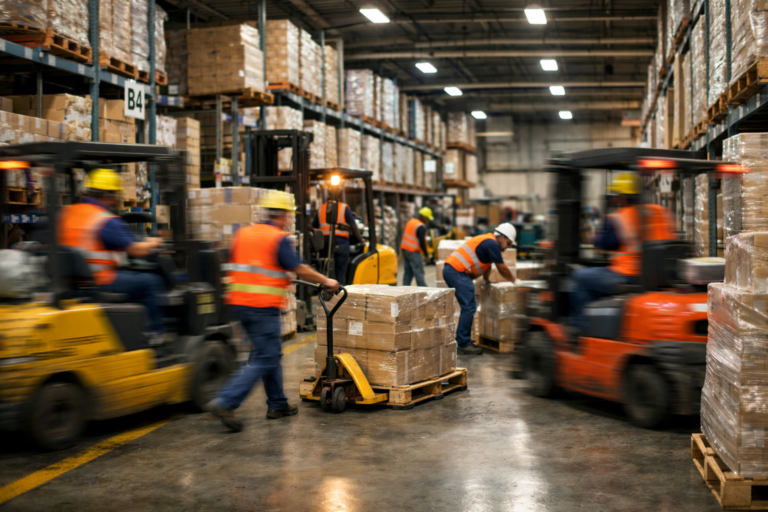
The truth is, warehouse productivity loss often hides inside normal routines. A delayed pallet move. A forklift waiting for clearance. A supervisor walking across the floor to verify inventory location. These actions feel minor, yet when repeated hundreds of times per week, they significantly impact throughput and profitability.
Without measurable visibility, warehouse productivity loss becomes normalized — and normalization is the most dangerous cost of all.
Most warehouse losses don’t show up as a line item. They don’t appear in a monthly report. They rarely trigger an alert.
Instead, warehouse productivity loss shows up quietly:
-
Forklifts waiting
-
People searching
-
Assets sitting idle
-
Small delays repeated all day
Individually, they feel harmless.
Together, they quietly drain productivity and profits.
For operations managers and safety leaders across North America, warehouse productivity loss is rarely caused by labor shortages alone. The real issue is much deeper.
It’s lack of visibility. If you can’t see where assets and people are right now, decisions are based on assumptions — not facts.
And assumptions are expensive.
The Real Cost of Invisible Delays
When we analyze warehouse productivity loss, we typically find the same patterns:
1. Forklifts Waiting Instead of Moving
A forklift operator waits 3 minutes for instructions. That happens 12 times per shift.
Multiply that by:
10 operators
250 working days
Average hourly wage + equipment cost
The number grows quickly. This isn’t a labor issue. It’s a visibility issue.
2. Workers Searching for Assets
How often do team members search for:
Pallets
Return bins
Specialized tools
High-value inventory
Even 5–10 minutes of search time per shift contributes significantly to warehouse productivity loss.
Without real-time location tracking, teams rely on memory, radio calls, or guesswork.
3. Idle Equipment That No One Notices
Assets sitting idle are invisible profit leaks.
You may own:
15 forklifts
200 rolling cages
500 high-value bins
But how many are actually being used efficiently? Without data, warehouse productivity loss hides inside asset utilization gaps.
Why Lack of Visibility Is the Core Problem
Most warehouses optimize:
-
Labor schedules
-
Critical paths
-
Safety compliance
But few optimize real-time awareness.
When you lack visibility:
-
Congestion goes undetected
-
Unsafe proximity incidents increase
-
High-value assets go missing
-
Maintenance is reactive instead of predictive
Warehouse productivity loss is not caused by bad teams. It’s caused by operating blind.
This is where UWB-based RTLS (Real-Time Location Systems) change the game.
Learn more about improving safety and efficiency in our related article: Warehouse Safety
How Real-Time Visibility Reduces Warehouse Productivity Loss
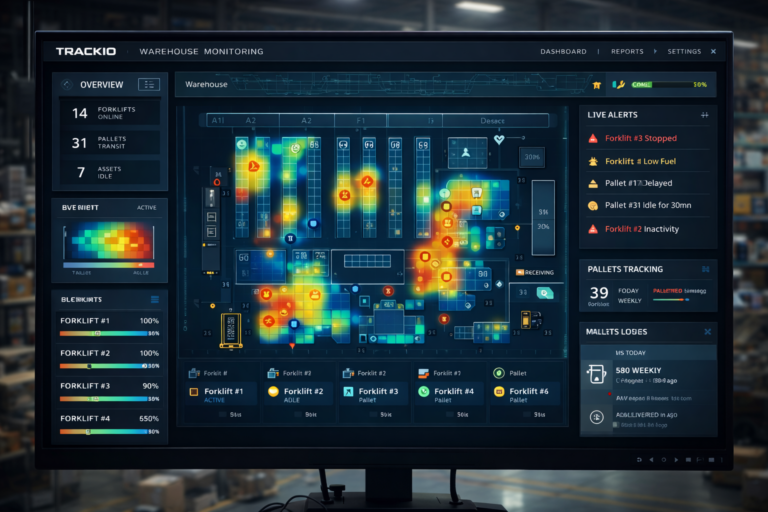
Ultra-Wideband (UWB) RTLS provides:
- Real-time forklift tracking
- Asset location in seconds
- Zone-based alerts
- Congestion heatmaps
- Idle time reporting
When managers can see movement patterns live, they can:
- Reallocate equipment
- Adjust staffing dynamically
- Prevent unsafe zone violations
Reduce unnecessary search time
Instead of reacting to problems after a shift ends, decisions happen in real time.
That’s how warehouse productivity loss gets eliminated at its source.
Industry Insight: The Hidden 5–15%
Multiple operational studies show that facilities lose between 5–15% productivity due to micro-delays and inefficient asset flow.
That percentage rarely appears in financial statements.
But it affects:
Throughput
On-time shipments
Overtime costs
Safety incidents
In competitive supply chains, that margin determines who wins contracts — and who doesn’t.
A Simple Question for You
What’s the one thing in your warehouse you wish you had real-time visibility into?
Forklift locations?
High-value assets?
Worker proximity zones?
Idle time reports?
That answer usually reveals where your warehouse productivity loss is hiding.
Stop Guessing. Start Seeing.
The gap between assumption and visibility is where profit leaks occur.
TrackioGuru helps warehouses across North America eliminate warehouse productivity loss using:
UWB precision tracking
Real-time dashboards
Zone-based safety alerts
Actionable analytics
If this sounds familiar, let’s talk.
A short demo often makes the visibility gap obvious.
Schedule Your Demo Today