
The Invisible Tax Inside Your Warehouse
Every warehouse has one.
It doesn’t appear on your P&L.
It’s not listed in your operating expenses.
But it quietly reduces margins every single day.
We call it Warehouse Productivity Leaks.
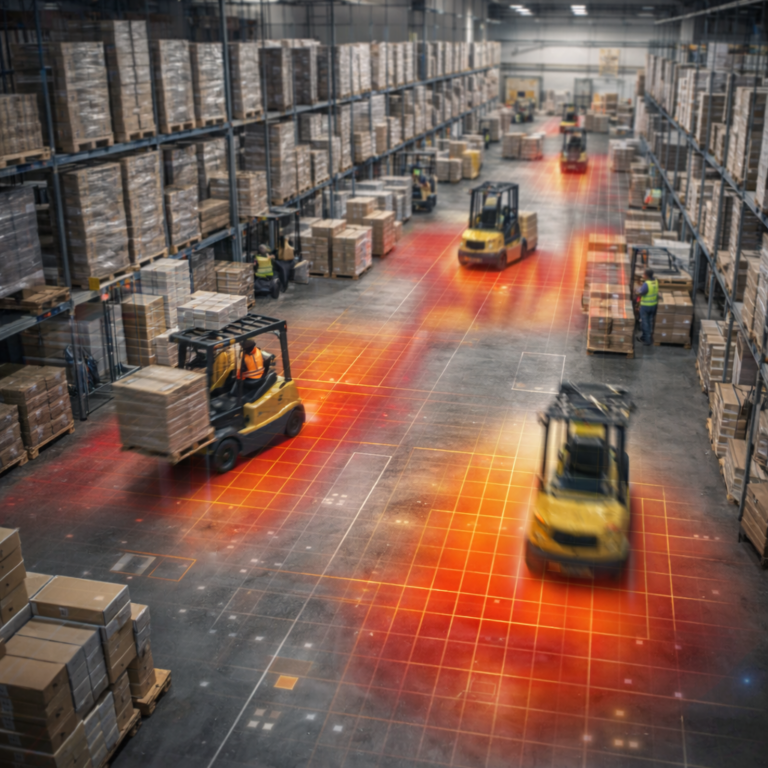
These leaks show up as idle forklifts, congestion in aisles, and employees searching for assets that should be easy to find. Individually, they look minor. Collectively, they create a silent tax on your operation.
And most facilities in the USA and Canada are paying it — without realizing how much.

What Are Warehouse Productivity Leaks?
Warehouse Productivity Leaks are the hidden inefficiencies caused by:
Idle equipment
Congested travel paths
Poor asset visibility
Manual coordination
Unmeasured downtime
They don’t trigger alarms. They don’t cause dramatic failures.
They simply drain throughput, increase labor cost, and stretch shift times.
Let’s make this practical.
Scenario 1: The Forklift That “Looks Busy”
A supervisor walks the floor.
Forklifts are moving. Operators are active. Everything appears productive.
But when reviewed over an 8-hour shift:
90 minutes were spent idling
45 minutes were lost waiting in congested zones
30 minutes were spent searching for pallets
That’s nearly 3 hours of hidden loss per forklift per shift.
Multiply that across 10 forklifts and 250 operating days.
This is how Warehouse Productivity Leaks quietly compound.
👉 Related reading: Forklift Safety & Operational Efficiency Insights
Scenario 2: The Congested Aisle That Slows Everything Down
Congestion rarely looks dramatic.
Two forklifts waiting to pass. A staging zone overflowing. A narrow aisle that becomes a bottleneck during peak receiving hours.
No one files an incident report. But picking times stretch. Shift change runs late. Overtime slowly increases.
This is another form of Warehouse Productivity Leaks — congestion that silently reduces throughput.
In high-volume facilities, even a 5% delay in movement can translate to:
Slower order fulfillment
Higher labor cost per unit
Increased stress on operators
Greater safety risk
Congestion is both a productivity and safety issue — and it often goes unmeasured.
Scenario 3: The “Lost but Not Lost” Asset
A pallet jack is somewhere in the building.
A high-value tool was moved during second shift.
A temperature-sensitive cart hasn’t been seen since morning.
The asset isn’t stolen. It’s just misplaced.
Two employees spend 20 minutes searching.
That’s 40 minutes of labor cost — for something that should take seconds.
Over weeks and months, this becomes one of the largest Warehouse Productivity Leaks inside large facilities.
Lost time searching = lost margin.
The Real Cost of Warehouse Productivity Leaks
Let’s put numbers to it.
If a mid-sized warehouse with 50 employees loses just:
20 minutes per person per shift
250 working days per year
That’s:
4,166 labor hours annually.
At $25/hour average loaded cost:
Over $100,000 per year in invisible loss.
And this doesn’t include:
Equipment depreciation from unnecessary movement
Increased safety exposure
Overtime creep
Missed SLA penalties
Warehouse Productivity Leaks are rarely dramatic — but they are measurable.
The Real Cost of Warehouse Productivity Leaks
Because the problem isn’t effort. Your team is working hard. The issue is visibility.
Without real-time insight into:
Equipment movement
Idle time patterns
Heatmaps of congestion
Asset location
You’re managing by observation instead of measurement. And observation misses patterns.
What High-Performing Warehouses Do Differently
Top-performing operations focus on visibility before expansion.
They measure:
Actual idle time per forklift
Congestion zones by time of day
Asset dwell time
Travel path inefficiencies
Once measured, small operational adjustments often recover 3–7% efficiency — without hiring more staff or expanding floor space.
That’s the difference between guessing and knowing. If you’re exploring visibility solutions, this overview explains zoning and real-time tracking approaches: Forklift Tracking
Where Real-Time Visibility Fits
This isn’t about adding complexity. It’s about seeing what already exists.
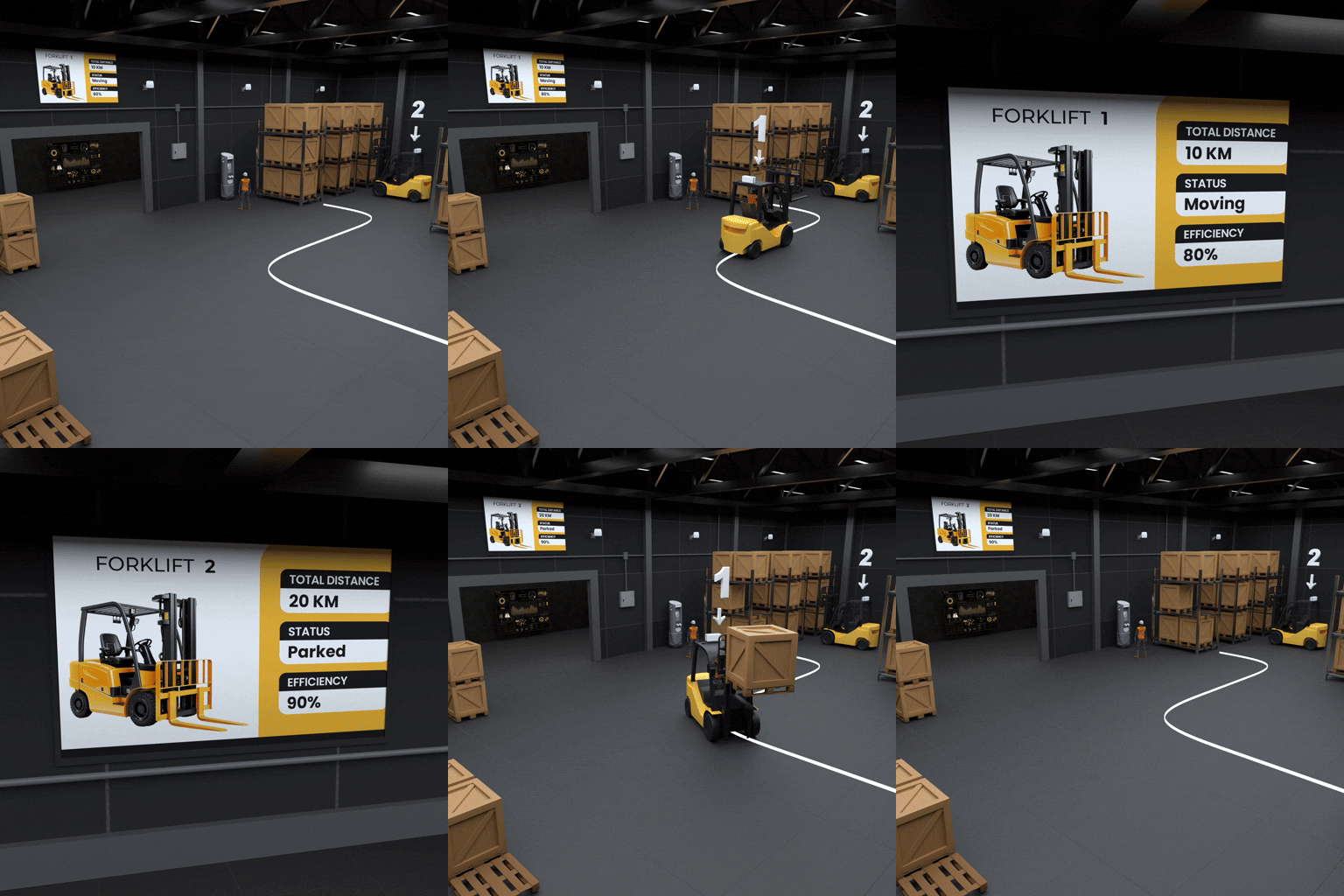
Modern RTLS systems (like UWB-based tracking) allow facilities to:
Track forklifts live
Measure idle vs. active time
Identify congestion heatmaps
Locate assets instantly
When Warehouse Productivity Leaks become visible, they become manageable. And when manageable, they become recoverable margin.
A Simple Question
If you recovered just 5% of lost time:
Would it reduce overtime?
Improve shift predictability?
Lower cost per order?
Most leaders don’t need new space. They need clarity.
Stop Paying the Invisible Tax
If this sounds familiar, let’s talk.
Happy to show how teams measure this in real time — no pressure.