
Frequently Asked Questions (FAQ)
Welcome to the UWB RTLS FAQ. This page answers the most common questions about UWB RTLS for forklift safety, warehouse visibility, and healthcare asset tracking. If you’re evaluating proximity alerts, patient flow, zone geofences, or analytics like heatmaps and spaghetti charts, this UWB RTLS FAQ gives you clear, actionable guidance. Need specifics for your site? Book a demo and we’ll map UWB anchors, tags, and server options (cloud/on‑prem) to your environment.
UWB RTLS FAQ — General Questions
Q1. What is RTLS and how does UWB differ from RFID/BLE?
RTLS provides live locations of assets and people indoors. UWB uses ultra‑wideband radio for high accuracy (often within tens of centimeters), making it better than passive RFID (line‑of‑sight scanning) and BLE (meter‑level accuracy) for safety‑critical use cases.
Q2. What accuracy can TrackioGuru’s UWB deliver?
In well‑planned deployments, you can expect ~10–30 cm accuracy in operational areas. Actual results depend on anchor placement, multipath conditions, and site layout. We validate with on‑site surveys and calibration.
Q3. Where is UWB RTLS most useful?
Warehouses, manufacturing floors, hospitals, labs, and high‑value asset rooms—anywhere visibility, safety, and speed matter. See our Warehouse RTLS and Healthcare RTLS hubs.
Q4. Will UWB interfere with existing Wi‑Fi or equipment?
UWB coexists with Wi‑Fi and most industrial systems. We perform RF surveys and follow placement best practices to avoid sensitive zones and comply with site policies.
Forklift Safety & Zone Alerts (UWB RTLS FAQ)
Q5. How does forklift proximity alerting work?
Tags on forklifts and wearables on workers transmit their positions. When objects enter a defined geofence or distance threshold, the system triggers visual/audio alerts or speed rules. See Forklift Tracking.
Q6. Can we slow forklifts in worker‑dense zones automatically?
Yes. You can set dynamic speed thresholds by location. Forklifts slow near docks, pick lines, or blind corners and return to normal speed in low‑risk zones.
Q7. What analytics help reduce congestion?
Heatmaps show dwell hotspots; spaghetti charts visualize travel paths, distance, and time. These reveal bottlenecks, unsafe crossings, and layout improvement opportunities.
Q8. What’s the ROI for forklift tracking?
Typical ROI comes from fewer incidents, higher throughput, and improved route efficiency. Ask us for our ROI calculator and a pilot plan tailored to your layout.
Healthcare Tracking (UWB RTLS FAQ)
Q9. What assets do hospitals typically track?
Infusion pumps, wheelchairs, beds, monitors, and specialty devices. RTLS reduces time spent searching, limits hoarding, and increases utilization.
Q10. Can RTLS support patient flow and safety?
Yes. Patient wrist tags support flow tracking, wander prevention, and response time analytics. Staff badges can trigger assistance or duress alerts.
Q11. Is UWB safe in clinical environments?
Yes. UWB operates at very low power. We follow hospital interference‑mitigation guidelines and perform site surveys to ensure safe operation.
Q12. Can RTLS integrate with EHR/EMR or nurse call?
We expose APIs and event webhooks to integrate with EHR workflows, nurse call, and locator dashboards. See Integrations for examples.
Deployment, Pricing & Support (UWB RTLS FAQ)
Q13. What hardware is required?
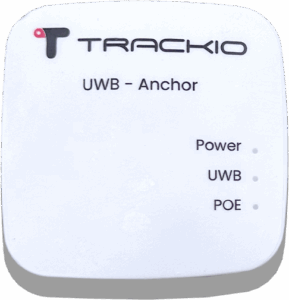
Anchors mounted on walls/ceilings, tags for assets/people, and a gateway/RTLS server (cloud or on‑prem). We design coverage for your target zones and accuracy.
Q14. How long does deployment take?
Small areas go live in days; larger sites typically roll out in phases over 2–6 weeks including surveys, mounting, calibration, and UAT.
Q15. Cloud vs on‑prem—what should we choose?
Cloud is fastest to start and simplest to maintain. On‑prem is ideal for strict data control, limited internet connectivity, or specific compliance requirements.
Q16. How are costs structured?
Hardware (anchors, tags), platform (subscription or license), and support tiers. We’ll recommend a package based on site size, accuracy targets, and integrations.
Integration, Security & Compliance (UWB RTLS FAQ)
Q17. How does TrackioGuru integrate with WMS/ERP/MES?
Via REST APIs, webhooks, and MQTT streams. We provide mapping of tag IDs to your asset records and zone events to your workflows.
Q18. Can we export raw location data?
Yes. You can export events and positions to your data lake/warehouse for BI tools, or query via APIs for real‑time applications.
Q19. Do you support SSO and role‑based access?
Yes. SSO (SAML/OIDC) and role‑based permissions per site, unit, or group ensure the right people see the right dashboards.
Security, Privacy & Compliance (UWB RTLS FAQ)
Q20. How is data secured?
Transport is encrypted (TLS), data is access‑controlled, and audit logs record changes. On‑prem deployments can keep data fully inside your network.
Q21. What about patient/worker privacy?
We minimize personal data, support pseudonymous tags, retention controls, and consent workflows aligned to your policies and regulations.
Q22. Do you meet healthcare or enterprise compliance needs?
We follow strict security practices and can support HIPAA‑aligned deployments with BAAs for applicable scopes. Ask about your specific requirements.
Analytics & Dashboards (UWB RTLS FAQ)
Q23. What reports are included?
Zone entry/exit, alerts & alarms, distance/time traveled, heatmaps, spaghetti paths, asset utilization, and custom reports.
Q24. Can we build custom dashboards?
Yes. Use built‑in widgets or connect BI tools (e.g., Power BI/Tableau) to our APIs for tailored analytics.
Q25. How do alerts get delivered?
On‑screen notifications, email/SMS, or webhook to third‑party systems. Thresholds and recipients are configurable per zone or asset class.
Still have questions?
Thanks for reading our UWB RTLS FAQ. For a tailored plan (forklift safety, zone alerts, healthcare assets), book a demo and we’ll share a quick coverage design, accuracy targets, and deployment options.