
If an OSHA inspector walked into your facility today and asked for proof of safety controls, what would you hand them?
Most warehouses still rely on incident reports, paper logs, and after-the-fact investigations. But in today’s regulatory environment, Real-Time Warehouse Compliance Data is becoming the difference between reactive documentation and proactive protection.
Incident reports explain what happened yesterday.
Real-time data proves what’s happening right now.
For operations managers, warehouse supervisors, and plant safety officers across North America, the shift toward Real-Time Warehouse Compliance Data isn’t just about technology — it’s about audit readiness.
The Compliance Gap: Reactive Reports vs. Live Tracking
Traditional compliance documentation includes:
Injury logs
Forklift certification records
Safety meeting attendance sheets
Manual zone violation reports
CCTV footage reviews (after incidents)
These are important — but they are reactive.
When regulators evaluate your facility, they increasingly want evidence of:
Active hazard monitoring
Proximity risk mitigation
Restricted zone enforcement
Preventative controls
Without Real-Time Warehouse Compliance Data, most warehouses can only prove what happened after an incident — not how they actively prevented one.
Can you show me how you monitor forklift-to-pedestrian interactions in real time?
Would your answer be:
“We train our operators well.”
“We have warning signs.”
“We review footage if something happens.”
Or could you show:
A live proximity alert log
Timestamped near-miss reports
Heatmaps of high-risk crossing zones
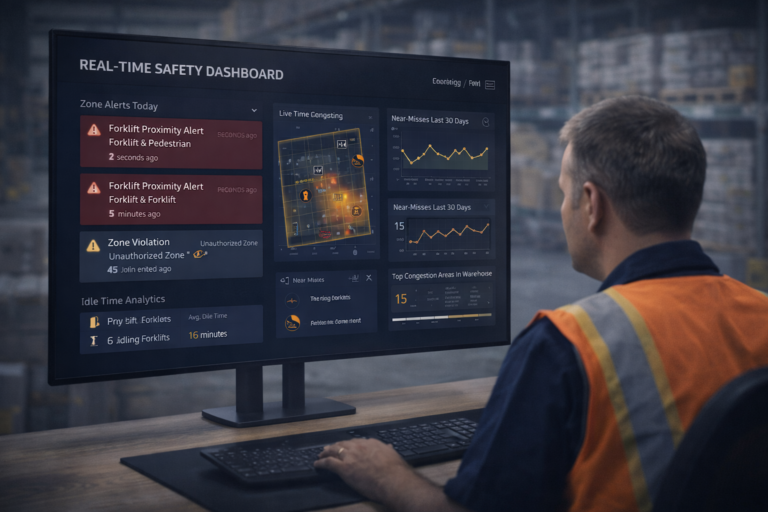
Real-Time Warehouse Compliance Data as Compliance Armor
Modern UWB-based RTLS systems provide measurable, timestamped, exportable compliance records.
With real-time tracking systems, you can generate:
Zone breach reports
Forklift-pedestrian proximity alerts
Movement history logs
Spaghetti diagrams for workflow analysis
Alert escalation records
Instead of explaining policies, you show evidence. Instead of describing procedures, you present reports.
What Real-Time Reports Look Like During an Inspection
Let’s imagine OSHA walks in. You open your RTLS dashboard.
Within seconds, you generate:
Restricted Zone Violation Report
Date range selectable
Employee ID anonymized if needed
Entry duration
Alert acknowledgment timestamp
Forklift Proximity Incident Log
Distance threshold triggers
Alert response time
Repeat violation tracking
High-Risk Zone Heatmap
Congestion hotspots
Peak traffic times
Recommended layout improvements
This is Real-Time Warehouse Compliance Data in action.
It transforms audits from stressful interrogations into structured data presentations.
How do you ensure employees don’t enter restricted areas?
Without real-time data:
You reference SOP manuals.
With real-time data:
You present 90-day zone breach analytics.
You show alert acknowledgment history.
You demonstrate declining violation trends.
That’s measurable control.
Industry Insight: Compliance Is Becoming Data-Driven
According to OSHA enforcement data trends, workplace safety violations increasingly involve:
Inadequate hazard communication
Failure to enforce restricted areas
Lack of documented preventative controls
Regulators are shifting from asking “Did you respond?” to asking: How do you actively prevent?
Real-time tracking bridges that gap.
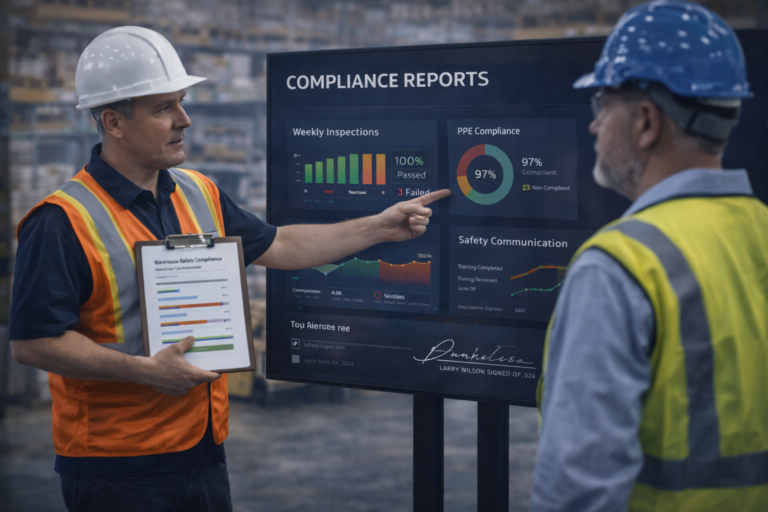
Show me evidence that you proactively reduced risk this quarter.
Could you show:
A 25% reduction in near-miss proximity alerts?
Congestion reduction after layout optimization?
Timestamped proof of live safety alerts?
If yes — you’re audit ready.
If no — there’s a visibility gap.
Why Incident Reports Alone Aren’t Enough
Incident reports tell a story after damage occurs.
Real-Time Warehouse Compliance Data tells the story before damage happens.
That’s the difference between:
Defensive documentation
Proactive risk mitigation
Warehouses using UWB-based RTLS are turning compliance into a strategic advantage — not just a regulatory requirement.
The Strategic Shift: From Documentation to Demonstration
Incident reports tell a story after damage occurs.
Real-Time Warehouse Compliance Data tells the story before damage happens.
That’s the difference between:
Defensive documentation
Proactive risk mitigation
Warehouses using UWB-based RTLS are turning compliance into a strategic advantage — not just a regulatory requirement.
If OSHA walked in today, would you feel confident opening your dashboard?
We’re happy to show how teams measure this in real time — no pressure.
If this sounds familiar, let’s talk. A short demo often makes the gap obvious.
