UWB Technology: Precision Real-Time Tracking
UWB Technology (Ultra-Wideband) is redefining how organizations achieve accurate RTLS (Real-Time Location Systems). Unlike RFID or BLE, UWB RTLS delivers 10–30 cm accuracy with live updates every second. This makes it the ideal choice for warehouse safety, forklift collision prevention, healthcare asset tracking, and patient flow management. At TrackioGuru, we combine anchors, tags, and intelligent RTLS software to create scalable solutions for medium to large facilities that need precision, safety, and efficiency.
Our UWB systems achieve sub-meter precision, offering a transformative edge for industrial automation, healthcare safety, warehouse efficiency, and operational visibility.
Want to see it in action? Book a demo.
What is UWB Technology?
UWB (Ultra-Wideband) is a short-range wireless communication protocol that uses very low energy levels for high bandwidth.
Accuracy: Positioning within 10–30 cm indoors
Frequency: Broad spectrum, enabling low interference with Wi-Fi or medical devices
Speed: Location updates every second, critical in time-sensitive environments
Why Choose UWB for Tracking?
- Sub-meter Location Accuracy – Ideal for real-time zone tracking
- Resistant to Signal Interference – Performs reliably in metallic and crowded environments
- Fast Update Rates – Suitable for monitoring fast-moving people or equipment
- High Tag Density – Track hundreds of tags simultaneously
- Scalable for Any Facility Size – From small labs to massive warehouses
How Trackio’s UWB System Works
- Attach UWB Tags to assets or personnel
- Anchors installed in the environment detect tag distances via time-of-flight signals
- A central RTLS engine calculates locations and feeds data to the Trackio dashboard
- Use alerts, zone controls, and analytics for decision-making
UWB Anchors (Fixed Reference Sensors)
Role: Permanently mounted reference devices that “hear” UWB signals from tags and synchronize timing for precise positioning.
Placement guidelines:
Mount 3–6 m (10–20 ft) high on walls or ceilings.
Provide line-of-sight to the zone where you need accuracy.
Space anchors so each tracked area is “seen” by ≥3 anchors for 2D, ≥4 for 3D coverage.
Power & network:
PoE (Power-over-Ethernet) is preferred for stable power and backhaul.
Backhaul via Ethernet; Wi-Fi possible for some models (use wired when you can).
Clock sync:
Supports TDoA deployments where anchors stay time-synchronized (via wired or wireless sync).
Environment:
Choose enclosures with IP-ratings (e.g., IP65+) for dusty/humid zones; avoid mounting near large metal structures that block RF.
Density planning:
Start with ~1 anchor per 15–25 m (50–80 ft) along long aisles and add more near intersections, blind corners, or high-risk areas.
UWB Tags (Mobile Transmitters)
Role: Battery-powered (or vehicle-powered) devices that broadcast UWB signals; the system computes each tag’s location.
Form factors:
Asset tags (small pucks for equipment), forklift tags (rugged, vehicle-powered), wearables (badges/wristbands for staff or patients).
Update rate & battery:
Typical 1 Hz (once/second) for live dashboards; adjustable 0.2–10 Hz to trade battery life vs. responsiveness.
With motion-based duty cycling, many tags reach 12–18+ months at ~1 Hz; vehicle-powered tags run continuously.
Safety & UX features:
LED/buzzer/haptic for proximity alerts, panic/assist buttons on staff badges, accelerometer for motion-aware updates.
Attachment:
Zip-tie plates, adhesive mounts, screws for assets; M12/M8 brackets or magnetic bases for forklifts.
Trackio UWB Anchor & Tag Specifications
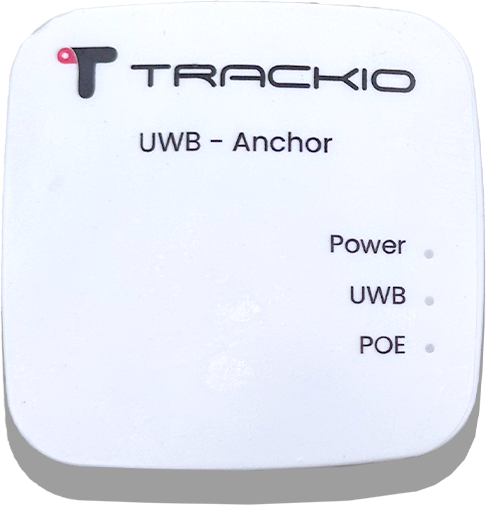
Trackio UWB Anchor Features:
- POE (Power Over Ethernet) and Wi-Fi Options
- 2D/3D Positioning Capable
- IP65 Dust/Water Resistant
- Supported Protocols: MQTT, HTTP, WebSocket
- Seamless integration with on-prem/cloud dashboard
- Compact Form Factor: 74 × 71 × 33 mm enclosure – ideal for discreet wall or ceiling mounting
- Wide Operating Temperature: Built to withstand harsh conditions with a range of -20°C to 80°C
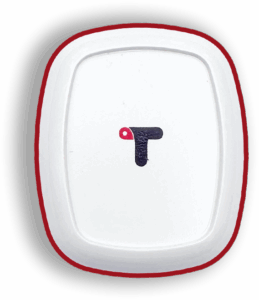
Trackio UWB Tag Features:
- Lightweight, wearable, or mountable designs
- Rechargeable via USB-C or replaceable battery
- Configurable broadcast intervals
- Motion & zone event triggers
- Available in IP-rated rugged body case or compact form